20:4 intermittent fasting: planning one 4-hour window
20:4 intermittent fasting means fasting for 20 hours and eating within a single 4-hour window, for example from 3 PM to 7 PM. The window usually holds one large meal and a small one, so the work is planning: getting enough protein and the day’s net carbs into two sittings. It is sometimes called the warrior diet schedule.
Key takeaways
- Fast 20 hours, eat within 4: for example 3 PM to 7 PM.
- Plan two meals, a small one and a large one, and the day’s protein between them.
- Get there through 16:8 and 18:6; it is not a first schedule.
- Keto Kit’s timer estimates a 20-hour fast spends its last 2 hours in the Autophagy stage.
Who should not start with 20:4?
Anyone for whom it would be a first fast. Twenty hours is built up to, not started with.
Talk to a doctor before any fasting if you
are pregnant or nursing, take medication for diabetes or blood pressure, have a history of eating disorders, or are under 18.
Wait if you
have not done 16:8 and 18:6 comfortably yet, or are in your first two weeks of keto, when Keto Kit’s fasting guide says not to start fasting at all.
Keto Kit is a tracking tool and does not give medical advice.
What does a 20:4 day look like?
One window, then nothing but the fast until the same time tomorrow. An afternoon or evening window keeps dinner in it. Pick a window and the fast’s stage times move with it.
Eat 3 PM to 7 PM. Fast 7 PM to 3 PM tomorrow.
Stage times are Keto Kit’s estimates from how long you have fasted, not measurements. What each stage means is on the fasting stages, hour by hour.
Your 20 hours, stage by stage
How do you get enough protein on 20:4?
Plan it before the window opens, because four hours leaves room for two meals at most. Split your daily target unevenly: a smaller meal to break the fast, and a larger one before the window closes. Keto macros puts most adults at 80 to 150g of protein a day; the keto calculator works out yours.
Meal 1, breaks the fast
at 3 PM
40g
Protein and fat, as Keto Kit’s guide breaks every fast: eggs, salmon or last night’s leftovers.
Meal 2, the large one
by 7 PM
80g
Most of the day’s net carbs, the guide’s carb-heavier meal later in the window, and the rest of the protein.
The split is about one third and two thirds, rounded to 10g; any split that reaches your target works.
And net carbs?
The limit does not change with the schedule: under 20g a day on strict keto, by keto macros. On 20:4 it is spent in two sittings, so pick the large meal first and fit the small one around what is left. Keto recipes list protein and net carbs per serving.
What can you have in the 20 hours?
Keto Kit’s guide lists water, plain coffee, plain tea and sparkling water as fine, and cream or butter in coffee as a gray area. Everything else is on what breaks a fast.
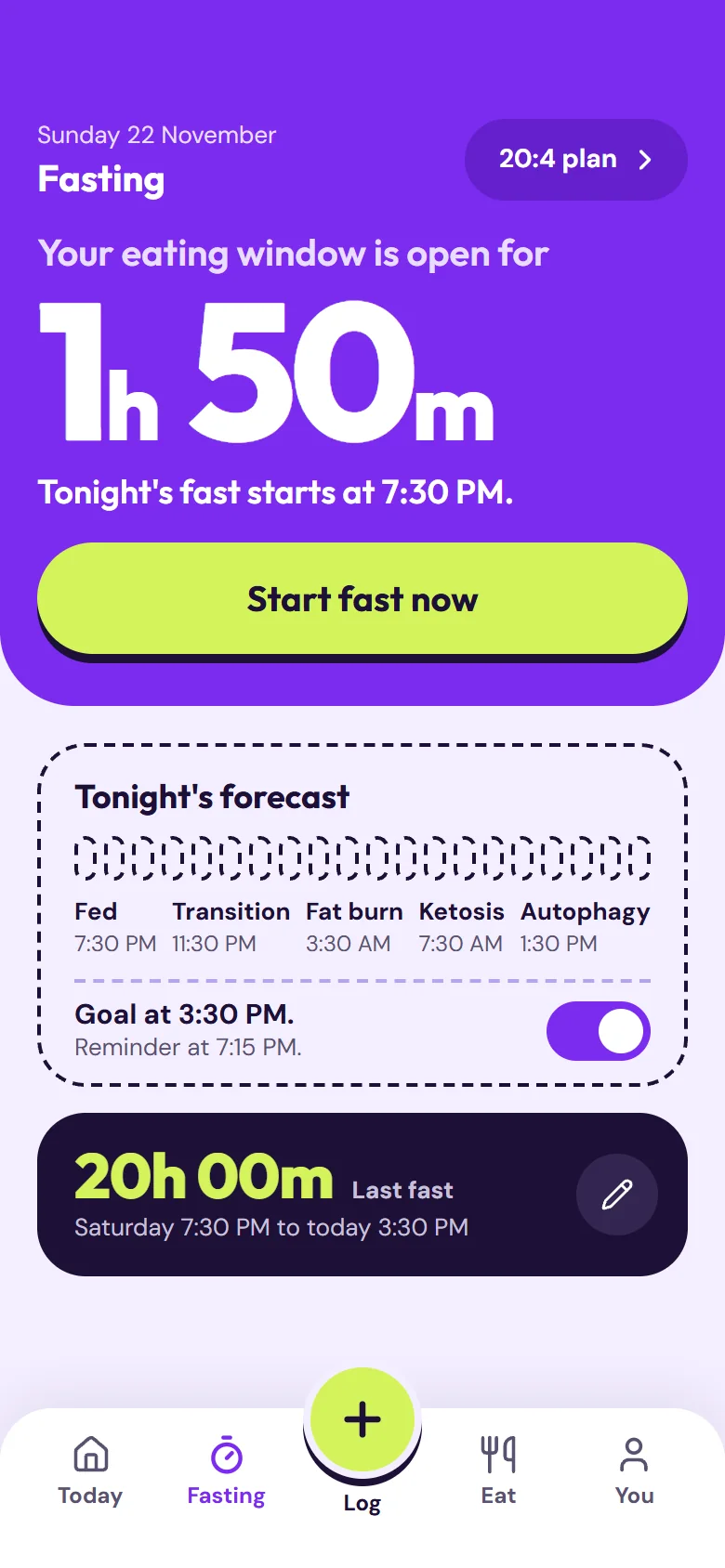
What comes next
- Transition11 PM
- Fat burn3 AM
- Ketosis7 AM
- Autophagy1 PM
- Goal, 20 hours3 PM
Reminders on
How does Keto Kit time a 20:4 fast?
20 hours is one of the free timer’s quick lengths. It forecasts when you reach each stage and when the window opens, and reminds you at the start and at your goal.
- 20 hours as your usual length in My plan, or for one fast only
- 19 hours on the way there: any length from 1 to 72 hours
- The weekly plan’s “Fill the gaps” puts meals inside your window
- Fast, meals and readings on one Today timeline
How do you move to 20:4?
By shrinking the window an hour or two at a time from a schedule that already feels easy. Keto Kit’s fasting guide reaches 16:8 in three weeks; from there, 18:6, then 19:5, then 20:4. Starting from scratch? Begin with 16:8.
16:8
An 8-hour window, two meals and a snack. The guide’s three-week target.
18:6
Six hours, two meals. Stay until it feels routine.
19:5
Five hours: the two meals move closer together.
20:4
Four hours: one small meal and one large one.
When should you step back?
When a fast keeps ending in the signs Keto Kit’s guide says to stop for. Then stop, have a small protein-and-fat meal, and reassess; if it happens again, go back to 18:6 or 16:8, whichever last felt fine. Feeling cranky or shaky near the end is often low sodium: the guide suggests a pinch of salt in water. See electrolytes on keto.
- Dizzy on standing
- A headache water and salt don’t fix
- Heart palpitations or nausea
- Extreme fatigue, beyond mild grogginess
Questions about 20:4 fasting
Is 20:4 the same as OMAD?
No. OMAD, one meal a day, puts all of the day’s food in a single meal. 20:4 keeps a 4-hour window, which leaves room for two meals. See OMAD fasting for that schedule.
Should beginners start with 20:4?
No. Keto Kit’s fasting guide starts with 12:12 and builds to 16:8 over three weeks, and only after the keto flu has passed. 20:4 comes after 16:8 and 18:6 feel comfortable.
How many meals do you eat on 20:4?
Usually two: a smaller meal that breaks the fast and a larger one a few hours later, before the window closes. Together they carry the whole day’s protein and net carbs.
Which fasting stages does a 20-hour fast reach?
By the hours, all five of Keto Kit’s timer stages: Fed, then Transition from about 4 hours, Fat burn from about 8, Ketosis from about 12 and Autophagy from about 18, for the last two hours. These are estimates from how long you have fasted, not measurements.
Can women do 20:4?
Keto Kit’s fasting guide notes that some women report hormonal changes on aggressive schedules such as OMAD or frequent 24-hour fasts, and that 14:10 or 16:8 is generally well tolerated by most women. If you notice symptoms, it suggests a shorter fasting window. Pregnant or nursing? Talk to a doctor before fasting.
Can I have coffee during a 20-hour fast?
Plain coffee, by Keto Kit’s fasting guide; cream or butter is a gray area. The full answer is on what breaks a fast.