The stages of fasting, hour by hour
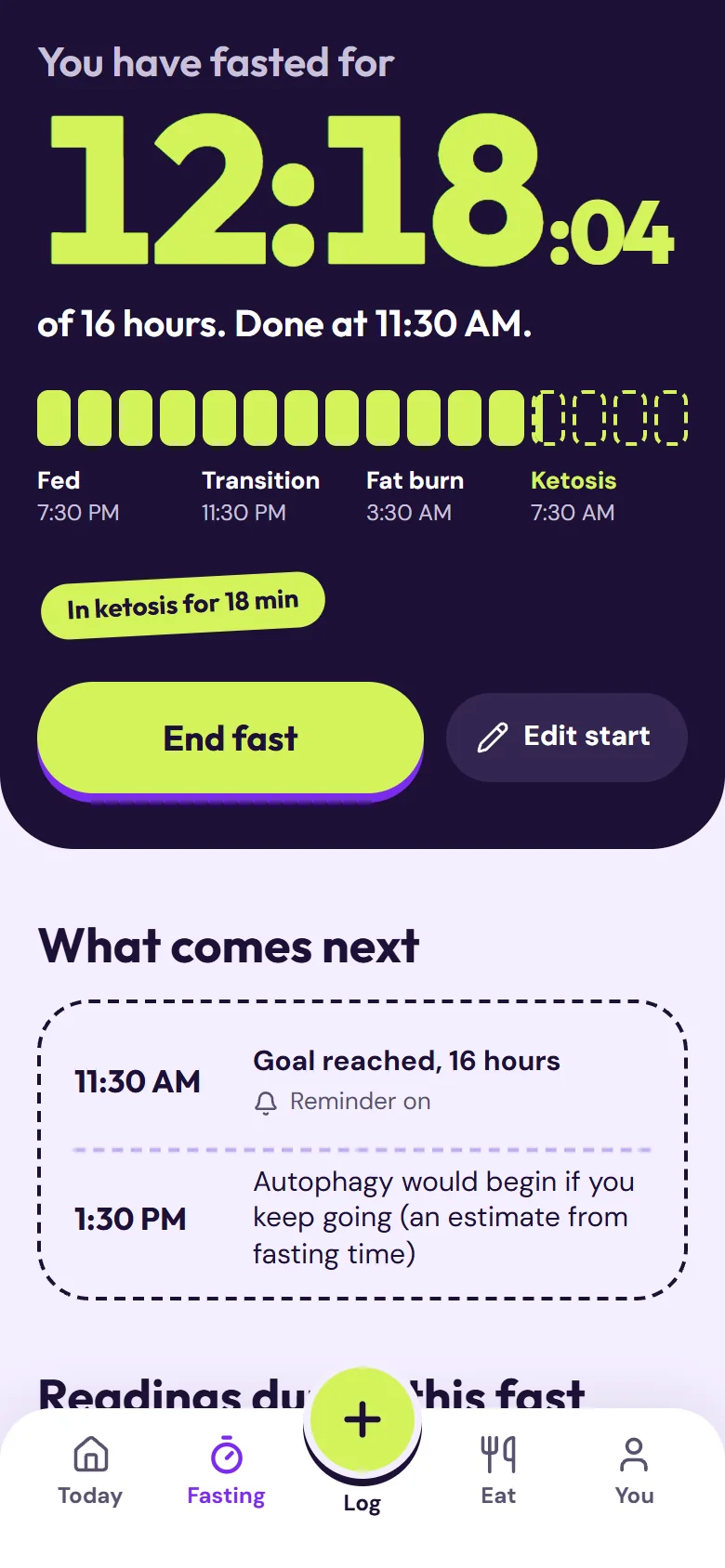
Keto Kit’s fasting timer names five stages by hours since your last meal: Fed from the start, Transition from about 4 hours, Fat burn from about 8, Ketosis from about 12 and Autophagy from about 18. These are estimates from how long you have fasted, not measurements; timing differs between people and with what and when you last ate.
What the timer knows
12 hours, counted from when you started
What it estimates
Only a ketone test measures it
Are the fasting stages real measurements?
No. The stage times are based on general physiological research. They’re a helpful guide, but they’re estimates from how long you have fasted, not personal lab measurements. Everyone’s metabolism is different, and your timing also depends on what and when you last ate. The only way to know you are in ketosis is to test.
Walk through a fast, one hour at a time
You have fasted for 12 hours Last meal at 7:30 PM, so it is now 7:30 AM the next day.
Tap an hour, a stage, or the arrows. The example fast starts when dinner ends at 7:30 PM.
From about 12 hours, to about 18
Ketosis
The timer’s ketosis mark. Whether you are in ketosis depends on far more than the clock: only a ketone test can tell.
Next on the timer: Autophagy at about 18 hours, 1:30 PM the next day.
Stage times are estimates from the hours, not measurements.
What happens at each stage of a fast?
What each stage means, in the order the timer reaches it, with what the site can and cannot say about it.
0h
From the start, 0 to about 4 hoursFed
The first hours after your last meal, while it is being digested. The timer starts here the moment you start a fast.
4h
From about 4 hours, to about 8Transition
The timer’s name for the hours between the fed stage and the fat-burn estimate. It is a stretch of the clock, not a test result.
8h
From about 8 hours, to about 12Fat burn
Fat-burning typically kicks in around the 8 to 12-hour mark as liver glycogen depletes. Glycogen is the glucose your body keeps in store. “Typically” is the honest word: it is a range from research, not a time for you.
Source Anton et al., 2018, Obesity
12h
From about 12 hours, to about 18Ketosis
Ketosis is a metabolic state in which the body burns fat (in the form of ketone bodies) for fuel instead of glucose. The timer marks it at about 12 hours, but the clock cannot tell you whether you are in it.
2–4 days
of keeping carbs to 20–50g a day is when most people enter nutritional ketosis
16+ hours
of fasting can speed this up by depleting glycogen faster, but it isn’t required
0.5–3.0
mmol/L of beta-hydroxybutyrate in the blood is generally how nutritional ketosis is defined
From the site’s entry on what ketosis is, which cites the work of Volek and Phinney.
18h
From about 18 hoursAutophagy
Autophagy is the process cells use to break down and recycle their own worn-out parts. Research on when it happens during a fast in people is limited, so treat this stage as the loosest estimate of the five. The site’s fasting guide puts it as increasing gradually from around hour 16 to 18, with an exact threshold that varies per person and per cell type.
24h+
Past 24 hours, with care
Extended fasts carry additional risks: electrolyte issues, hypoglycemia, and refeeding syndrome on long fasts. Don’t attempt a 24-hour fast until you’ve done 16:8 comfortably for 4 weeks or more. Don’t attempt 48 hours or more without medical guidance.
Why your hours may not match the clock
The timer counts hours. Your body answers to more than hours. These are the things the site already names that move ketosis earlier or later.
What you last ate
A carb-heavy meal resets it
A single meal with 50+ grams of carbs will typically exit ketosis within hours. Returning usually takes another 1–3 days of strict carb restriction.
How long you have eaten keto
Days for ketosis, weeks to adapt
Reaching ketosis takes 2–4 days of carb restriction. Becoming fat-adapted takes 4–8 weeks. Fat adaptation
Stress and sleep
Can lower ketones for a while
Acute stress raises cortisol, which raises blood glucose and temporarily lowers ketone levels, even when you haven’t eaten carbs.
Exercise
Long effort counts too
Prolonged endurance exercise can induce ketosis on its own, as can extended fasting of 24 hours or more.
How do you know you are in ketosis?
You test. Blood ketone meters are the most reliable measurement. The other methods are rougher, and how you feel is a direction, not a number.
In Keto Kit you can log ketone and glucose readings for free, and they sit on the same Today timeline as your fast.
- 1Blood ketone meterThe most reliable measurement. Nutritional ketosis is generally 0.5–3.0 mmol/L of beta-hydroxybutyrate.
- 2Breath ketone analyzerMeasures acetone. A non-invasive alternative that correlates roughly with blood ketones.
- 3Urine stripsWork in the first week or two, then become unreliable as the body adapts and reabsorbs ketones.
- 4How you feelReduced hunger, steadier energy, a metallic or fruity breath. Reliable directionally, but imprecise.
See the stages coming in Keto Kit
The fasting timer is free. Start a fast and it forecasts when each stage is due, with reminders. Pick 12, 14, 16, 18, 20 or 24 hours, or any length from 1 to 72 in one-hour steps.
Questions about the stages of fasting
Last updated . This page is a tracking and education resource, not medical advice. Consult a doctor before starting keto or fasting if you have a medical condition.
Are the fasting stage times accurate?
They’re a helpful guide based on general physiological research, but they’re estimates, not personal lab measurements. Everyone’s metabolism is different. The stages are there to keep you motivated through a fast, not to replace lab work or a ketone test.
When does fat burning start during a fast?
Fat-burning typically kicks in around the 8 to 12-hour mark as liver glycogen depletes (Anton et al., 2018, Obesity). That is a typical range, not a time you can count on for yourself.
How many hours of fasting until ketosis?
There is no single number. Keto Kit’s timer marks ketosis at about 12 hours as an estimate. Most people enter nutritional ketosis within 2–4 days of keeping carbs to 20–50 grams a day, and a 16+ hour fast can speed that up. A blood ketone meter is the only way to know.
When does autophagy start on a fast?
The site’s fasting guide says cellular autophagy increases gradually starting around hour 16 to 18, and that the exact threshold varies per person and per cell type. Research on its timing in people is limited, which is why the timer’s 18-hour mark is the loosest of its five estimates.
Can I be in ketosis without doing keto?
Yes. Extended fasting (24+ hours), prolonged endurance exercise and very-low-carb periods can all induce ketosis without a formal ketogenic diet. The metabolic state itself is a normal physiological response to glucose scarcity.
Does the timer know what I ate?
The stages come from the hours you have fasted. To see what your body is actually doing, add a ketone or glucose reading: it sits on the same Today timeline as the fast and your meals.